Ir para o conteúdo

Questões de Interpretação de Texto em Inglês no ENEM

94 questões encontradas · página 5 de 10

LETTER TO THE EDITOR: Sugar fear-mongering unhelpful

By The Washington Times Tuesday, June 25, 2013

In his recent piece “Is obesity a disease?” (Web, June 19), Dr. Peter Lind refers to high-fructose corn syrup and other “manufactured sugars” as “poison” that will “guarantee storage of fat in the body.” Current scientific research strongly indicates that obesity results from excessive calorie intake combined with a sedentary lifestyle. The fact is Americans are consuming more total calories now than ever before. According to the U.S. Department of Agriculture, our total per-capita daily caloric intake increased by 22 percent from 2,076 calories per day in 1970 to 2,534 calories per day in 2010 — an additional 458 calories, only 34 of which come from increased added sugar intake. A vast majority of these calories come from increased fats and flour/ cereals. Surprisingly, the amount of caloric sweeteners (i.e. sugar, high-fructose, corn syrup, honey, etc.). Americans consume has actually decreased over the past decade. We need to continue to study the obesity epidemic to see what more can be done, but demonizing one specific ingredient accomplishes nothing and raises unnecessary fears that get in the way of real solutions.

JAMES M. RIPPE

Shrewsbury, Mass.

Disponível em: www.washingtontimes.com. Acesso em: 29 jul. 2013 (adaptado).

Ao abordar o assunto “obesidade”, em uma seção de jornal, o autor

0% acertam

In this life

Sitting on a park bench

Thinking about a friend of mine

He was only twenty-three

Gone before he had his time.

It came without a warning

Didnꞌt want his friends to see him cry

He knew the day was dawning

And I didnꞌt have a chance to say goodbye.

MADONNA. Erotica. Estados Unidos: Maverick, 1992.

A canção, muitas vezes, é uma forma de manifestar sentimentos e emoções da vida cotidiana. Por exemplo, o sofrimento retratado nessa canção foi causado

Quer ver o gabarito comentado e sua nota TRI?

Crie sua conta gratuita em menos de 1 minuto e acompanhe sua nota estimada por área.

Criar conta grátis

If children live with criticism, they learn to condemn.

If children live with fear, they learn to be apprehensive.

If children live with pity, they learn to feel sorry for themselves.

If children live with ridicule, they learn to feel shy.

If children live with tolerance, they learn patience.

If children live with praise, they learn appreciation.

If children live with acceptance, they learn to love.

If children live with approval, they learn to like themselves.

If children live with recognition, they learn it is good to have a goal.

If children live with sharing, they learn generosity.

If children live with fairness, they learn justice.

If children live with kindness and consideration, they learn respect.

If children live with friendliness, they learn the world is a nice place in which to live.

NOLTE, D. L. Disponível em: www.americanfamilytraditions.com. Acesso em: 30 jul. 2012.

Valores culturais de um povo revelam sua forma de ser, agir e pensar. Na concepção da autora, as diferentes formas de educar crianças nos Estados Unidos confirmam que as crianças

100% acertam

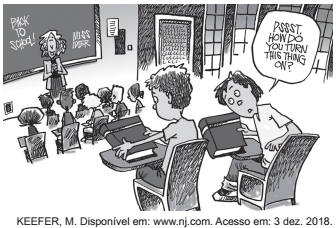
Imagem associada para resolução da questão

No cartum, o estudante faz uma pergunta usando turn this thing on por

0% acertam

Lava Mae: Creating Showers on Wheels for the Homeless

San Francisco, according to recent city numbers, has 4,300 people living on the streets. Among the many problems the homeless face is little or no access to showers. San Francisco only has about 16 to 20 shower stalls to accommodate them.

But Doniece Sandoval has made it her mission to change that. The 51-year-old former marketing executive started Lava Mae, a sort of showers on wheels, a new project that aims to turn decommissioned city buses into shower stations for the homeless. Each bus will have two shower stations and Sandoval expects that they'll be able to provide 2,000 showers a week.

ANDREANO, C. Disponível em: http://abcnews.go.com. Acesso em: 26jun. 2015 (adaptado).

A relação dos vocábulos shower, bus e homeless, no texto, refere-se a

Don't write in English, they said,

English is not your mother tongue...

...The language I speak

Becomes mine, its distortions, its queerness

All mine, mine alone, it is half English, half

Indian, funny perhaps, but it is honest,

It is as human as I am human...

...It voices my joys, my longings my

Hopes...

(Kamala Das, 1965:10)

GARGESH, R. South Asian Englishes. In: KACHRU, B. B; KACHRU, Y.; NELSON, C. L. (Eds.). The Handbook of World Englishes. Singapore: Blackwell, 2006.

A poetisa Kamala Das, como muitos escritores indianos, escreve suas obras em inglês, apesar de essa não ser sua primeira língua. Nesses versos, ela

0% acertam

TEXTO I

A Free World-class Education for Anyone Anywhere

The Khan Academy is an organization on a mission. We're a not-for-profit with the goal of changing education for the better by providing a free world-class education to anyone anywhere. All of the site's resources are available to anyone. The Khan Academy's materials and resources are available to you completely free of charge.

Disponível em: www.khanacademy.org. Acesso em: 24fev. 2012 (adaptado).

TEXTO II

I didn't have a problem with Khan Academy site until very recently. For me, the problem is the way Khan Academy is being promoted. The way the media sees it as “revolutionizing education”. The way people with power and money view education as simply “sit-and-get”. If your philosophy of education is “sit-and-get”, i.e., teaching is telling and learning is listening, then Khan Academy is way more efficient than classroom lecturing. Khan Academy does it better. But TRUE progressive educators, TRUE education visionaries and revolutionaries don't want to do these things better. We want to DO BETTER THINGS.

Disponível em: http://fnoschese.wordpress.com. Acesso em: 2 mar. 2012.

Com o impacto das tecnologias e a ampliação das redes sociais, consumidores encontram na internet possibilidades de opinar sobre serviços oferecidos. Nesse sentido, o segundo texto, que é um comentário sobre o site divulgado no primeiro, apresenta a intenção do autor de

Most people today have a mobile phone. In fact, many people can't imagine how they ever got along without a portable phone. However, many people also complain about cell phone users. People complain about other people loudly discussing personal matters in public places. They complain when cell phones ring in movie theaters and concert halls. They complain about people driving too slow, and not paying attention to where they are going because they are talking on a cell phone. And they complain about people walking around talking to people who aren't there.

Whenever a new communications technology becomes popular, it changes the way society is organized. Society has to invent rules for the polite way to use the new devices. Our social etiquette, our rules of politeness for cell phones, is still evolving.

Disponível em: www.indianchild.com. Acesso em: 28 fev. 2012 (adaptado).

O uso de celulares em lugares públicos tem sido prática corrente. O texto aponta que essa prática tem gerado

One of the things that made an incredible impression on me in the film was Frida’s comfort in and celebration of her own unique beauty. She didn’t try to fit into conventional ideas or images about womanhood or what makes someone or something beautiful. Instead, she fully inhabited her own unique gifts, not particularly caring what other people thought. She was magnetic and beautiful in her own right. She painted for years, not to be a commercial success or to be discovered, but to express her own inner pain, joy, family, love and culture. She absolutely and resolutely was who she was. The trueness of her own unique vision and her ability to stand firmly in her own truth was what made her successful in the end.

HUTZLER, L. Disponível em: www.etbscreenwriting.com. Acesso em: 6 maio 2013.

A autora desse comentário sobre o filme Frida mostra-se impressionada com o fato de a pintora